
Davis County Criminal History Checks
Begin by naming the event and the proof needed. A current jail stay belongs in the Davis County inmate roster. A filed charge, plea, dismissal, or sentence belongs in Utah Courts XChange and at the filing court. The Bureau of Criminal Identification, known as BCI, supplies a subject with their own Utah criminal history. The statewide warrant search points to active public warrant data, while a police narrative must come from the Davis County Sheriff or city police department that wrote it. No single result replaces all five record sources.
Good identifiers prevent a false match. Use a full name, known spelling variants, date of birth when the portal permits it, and a case or citation number when available. In XChange, choose District Court, Justice Court, or both. A county or court filter helps with common names. The first two digits of a Utah case number show its filing year, but case and citation numbers are not unique across the state.
- Choose custody, court, BCI, warrant, or agency-report records based on the question.
- Search with a full name, then narrow by Davis County, court, birth date, case type, or date range.
- Open the case history or inmate detail and match identifiers before drawing any conclusion.
- Read each charge's plea and disposition because the arrest allegation and final result may differ.
- Ask the filing clerk for a certified copy, or use BCI Right of Access for an official personal Utah history.
Davis County Record Systems Compared
The Davis County Sheriff's Office, XChange, and BCI answer different questions. The Davis County Sheriff creates incident and booking records. Court staff enter the prosecutor's filed case and later rulings into CORIS, which feeds public data to XChange after entry. BCI receives fingerprint-supported arrest information and reported outcomes for the Utah Computerized Criminal History file. An incident with no qualifying fingerprints may never form a BCI arrest cycle. An old BCI entry may also lack its final court result if the disposition was not matched back.
The official Davis County Sheriff overview shows the office behind local law-enforcement and corrections services.
That Davis County entry point is useful for Davis County reports and jail services, while the court and BCI remain separate custodians. The flow is best read as: arresting agency → Davis County booking when jailed → prosecutor and court case → disposition report to BCI. Searchers should compare the charge at each stage instead of treating the first label as final.
Official Background Checks in Utah
Utah has no general-public BCI name search for another person's rap sheet. The official personal-review route is BCI Utah Criminal History Right of Access. It costs $20 and requires the application, valid government photo identification, and the instructed four-finger flat impression. A third-party release can direct where the subject's result is sent, but it does not turn the state repository into an open people-search system. A person who sees an error may file a $20 BCI Record Challenge and compare the entry with the court disposition.
The BCI Right of Access page sets out the subject-only criminal history process.
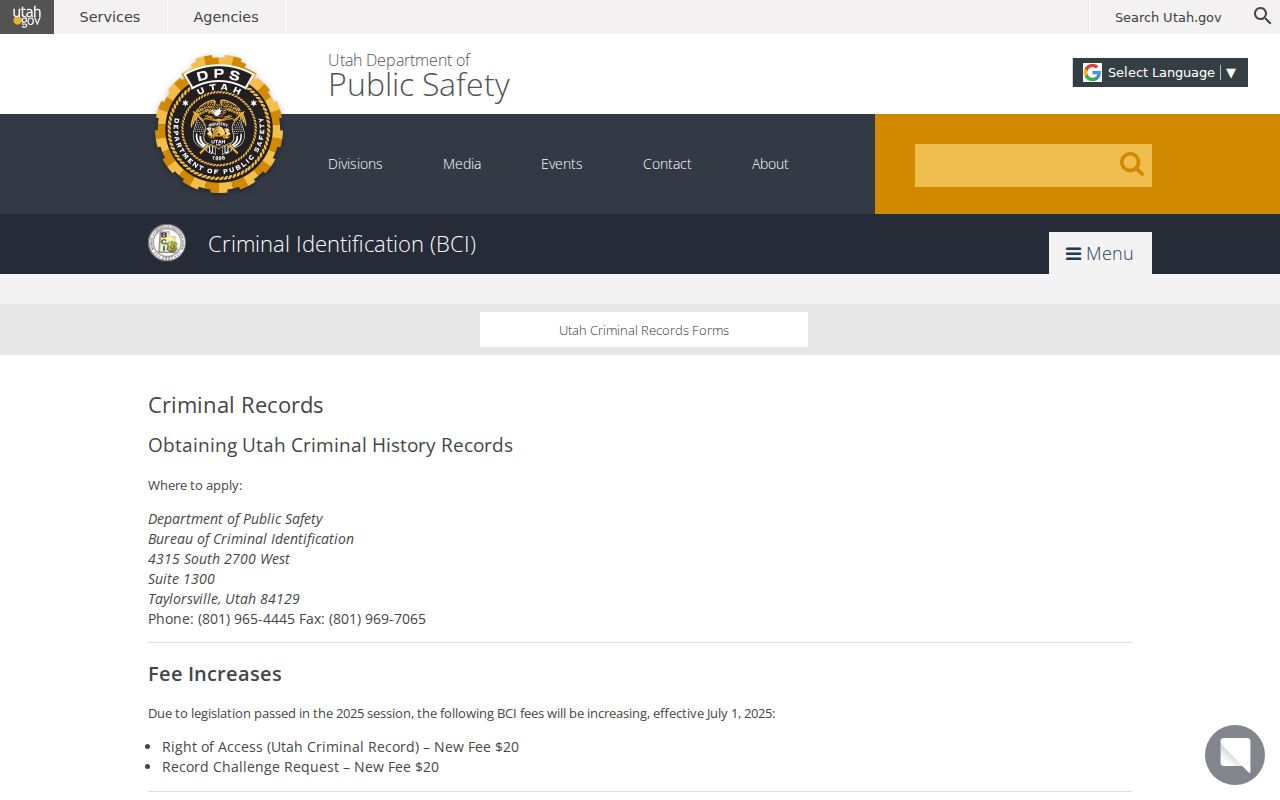
This official channel covers Utah repository history, not every court document or local report. For a national personal review, the FBI Identity History Summary costs $18 plus any capture or mailing expense. It also remains a subject-access product. XChange is the better source for the procedural case file and its charge-by-charge outcome. The BCI fingerprint service page explains appointment-based capture in Taylorsville.
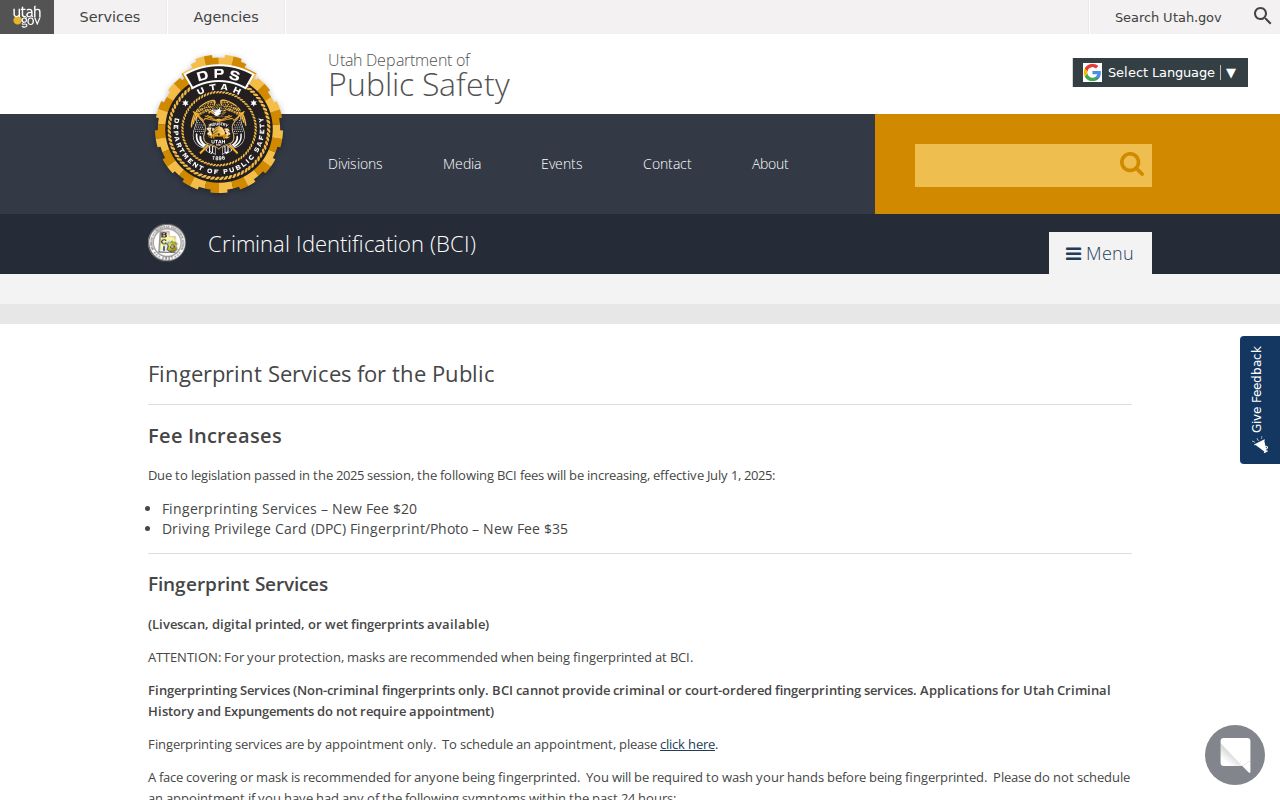
BCI charges $20 for its print service and provides up to three cards, then charges $5 for each added card. Davis County residents may instead book sheriff fingerprinting for $15 plus a card transaction charge at 801-451-4299. The Davis County Sheriff also offers a no-cost local letter in person with identification for stated personal needs such as adoption, citizenship, international travel, or a mission. That letter can address current local warrants or proceedings, but it is not the statewide BCI record.
Davis County Criminal Records Campus
Several key custodians share the Davis County Justice Complex at 800 W State Street in Farmington. Sheriff administration, the Correctional Facility, Davis County Justice Court, the Davis County Attorney, and Farmington Second District functions operate on the campus. They do not merge their files. The Davis County Sheriff holds its reports and booking material. Davis County Justice Court handles county-jurisdiction class B and C misdemeanors, infractions, and ordinances. Second District is the felony and class A misdemeanor court.
The Sheriff records FAQ identifies report, identification, warrant, and fingerprint routes used at the Davis County level.
The image reflects a practical point: one campus still has several counters. Call the Davis County Sheriff at 801-451-4100 for its services, Corrections at 801-451-4200 for jail routing, Davis County Justice Court at 801-451-4488 for that court's files, and Farmington Second District at 801-447-3800 for district cases. Public hours listed for the Davis County offices are weekdays from 8 a.m. to 5 p.m. Court security screens all entrants, and anyone bringing recording equipment should first check the courthouse orders linked by Utah Courts.
Davis County Sheriff
800 W State Street
Farmington, UT 84025
801-451-4100
Davis Justice Court
800 W State Street, Courtroom 2
Farmington, UT 84025
801-451-4488
Second District Court
800 W State Street
Farmington, UT 84025
801-447-3800
Kinds of Criminal Records
A Davis County criminal record may mean an incident narrative, a jail booking, a court docket, a BCI arrest cycle, a warrant, or a supervision entry. Each begins at a different point. Police write an incident or arrest report. The Davis County Correctional Facility creates a booking record when a person enters custody. Prosecutors file a complaint or information, then courts record pleas, hearings, rulings, the disposition, and sentence. BCI maintains the fingerprint-supported state history. Utah Department of Corrections records cover state prison, probation, and parole.
The distinction matters most when records seem to conflict. A police report can exist without an arrest. An arrest can end without a filed charge. A filed charge can be amended or dismissed. The final judgment can differ from both the report and booking allegation. A registry entry is a notification record under Utah Code Title 53, Chapter 29, not proof of a new crime. The source closest to the fact being checked is usually the sound starting point.
- Incident report: agency narrative, time, place, alleged conduct, officer, and evidence, subject to GRAMA limits.
- Booking record: current Davis County custody data, booking date, identifiers, detail, and bail information.
- Court case: filed charges, pleas, proceedings, charge outcomes, sentence, money accounting, and public documents.
- BCI history: fingerprint-supported Utah arrest cycles and outcomes reported to the state repository.
- Custody or supervision: Davis County jail, UDC prison, probation, parole, and Board hearing records in separate systems.
Davis County GRAMA Record Requests
Davis County uses NextRequest for sheriff and other county requests under the Government Records Access and Management Act, or GRAMA. Its visible controls are Search, All Requests, and Make Request. The inner fields appear during the interactive account workflow, so a requester should not assume a hidden field list. Describe the wanted record with enough detail to locate it. Useful facts include the incident number, date, time, location, involved person, creating agency, and the exact media or narrative sought.
The official Davis County NextRequest portal supplies the formal online request route.
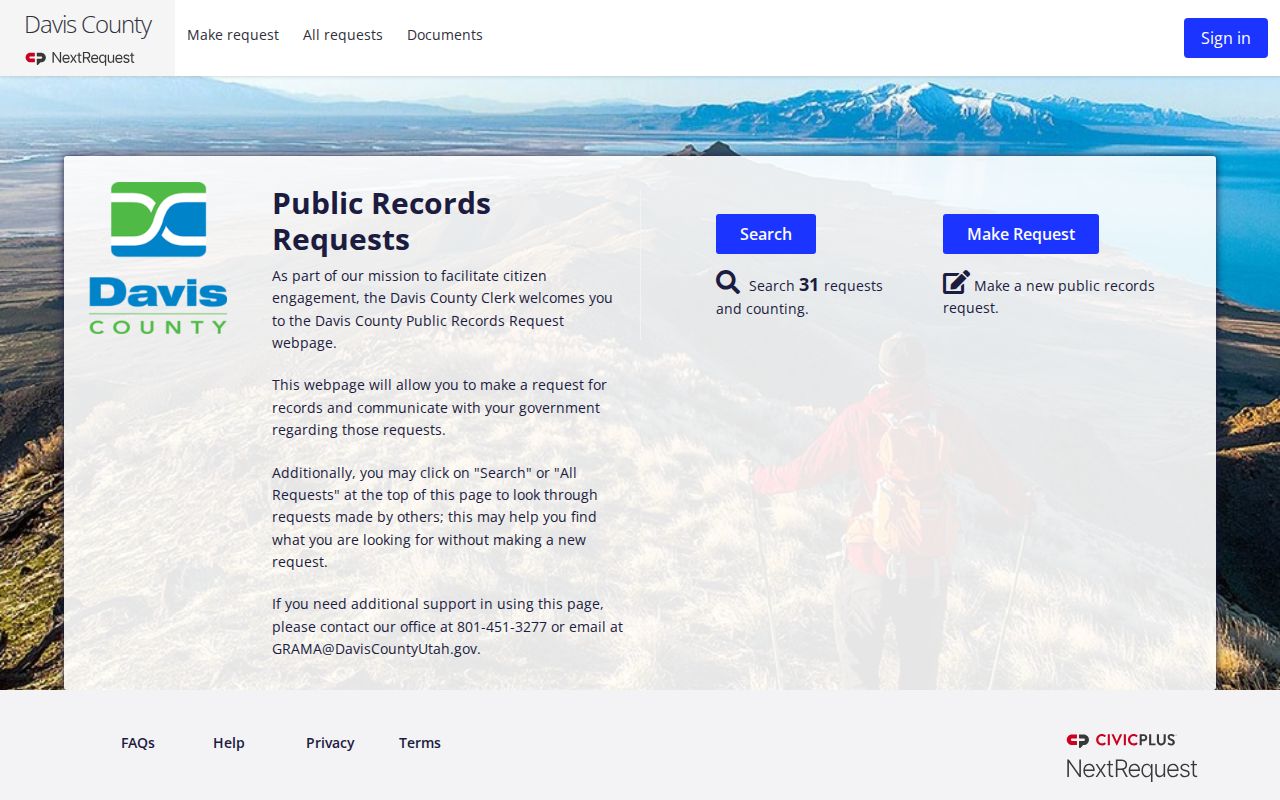
The portal does not make restricted content public. Active investigations, juvenile material, victim information, and personal identifiers may be withheld or redacted. The Davis County Sheriff requires a complete request and current government photo identification. Police and investigative reports cost $10, while other Davis County Sheriff documents cost $0.25 per page. Large requests receive an estimate, and Davis County Sheriff records payment is cash only. GRAMA allows up to ten working days for an ordinary response or denial; a denial must state the reason and appeal path.
| Record service | Current amount or rule |
|---|---|
| Sheriff police or investigative report | $10 processing fee |
| Other sheriff documents | $0.25 per page |
| Large request | Estimate supplied before processing |
| Local sheriff letter | No charge, in person with ID |
| Davis resident fingerprints | $15 plus card charge, by appointment |
| Ordinary GRAMA response | Up to 10 working days |
Davis County Criminal Records: What They Contain
Contents depend on the custodian. A BCI history can show names, aliases, date of birth, physical descriptors, a Utah state identification number, FBI number, arrest date and agency, tracking identifiers, arrest charges, reported court result, amended charge, plea, level, and date. XChange adds the judge, parties, attorneys, agency or officer, prosecutor, hearings, chronological events, finance entries, sentence, and links to available documents. The roster is a much narrower current-custody snapshot.
Read at charge level. One Davis County case can contain several counts with different pleas and dispositions. “Disposition” means the result of a charge. A dismissal ends that charge without a conviction. A plea in abeyance is a Utah plea held without a conviction while stated conditions are completed. The case caption alone cannot show those details.
| Name and identifiers | Name, aliases, date of birth, descriptors, state ID, FBI number, or case-linked identifiers when public. |
|---|---|
| Arrest and booking | Arrest date, agency, alleged charges, booking date, age, gender, detail link, and bail information by source. |
| Charges and statutes | Arrest allegations, filed counts, charge level, statute, amended charge, citation, and violation date. |
| Disposition | Plea, dismissal, acquittal, conviction, or other result for each charge, with its date and code. |
| Sentence | Custody, probation, fine, restitution, and court-ordered conditions recorded in the judicial file. |
| Custody or supervision | Current jail custody, state prison status, UDC probation or parole, and Board hearing information in separate systems. |
Davis County Custody Record Paths
Use the Davis County inmate roster for current custody at the Davis County Correctional Facility. It is free, requires no login, and displays a timestamp. The list includes booking date, first and last name, age, gender, pagination, and an inmate-details link. Davis County guidance says the detail page refreshes every 15 minutes and is informational rather than an official legal record. A temporary error message once appeared while entries still remained, so retry before concluding that no one is held.
Utah law keeps booking photos off the public Davis County roster, and release dates or times are not posted for safety. A missing photo does not mean the page failed. Historical sheriff booking material requires a GRAMA request. After transfer to a Utah prison or state supervision, use the UDC Offender Search. It accepts first and last name, optional middle name, or offender number and covers prison, probation, and parole. It does not cover an unsentenced Davis County detainee.
The custody chain is short but strict: Davis roster for current Davis County jail → Davis County Sheriff GRAMA for historic local booking → UDC locator for prison or AP&P status → Board search for parole hearings and decisions. VINE provides custody notifications at 1-877-884-8463. The Davis County Sheriff has no official mobile records app; the NCIC app is for jail communication, not lookup.
Note: An arrest or booking is not proof of guilt, and the later court disposition may differ from the initial custody allegation.
Utah Public Access Laws
GRAMA starts from a right to inspect and copy public government records, but Utah classifies some material as private, protected, controlled, sealed, or nonpublic. Public court access is broader than access to a BCI rap sheet. That is why a person may find an adult case in XChange yet cannot search another person's full BCI history by name. Unserved warrants, juvenile cases, victim details, and expunged records can also be kept from ordinary public view.
Davis County local practice adds concrete steps. The sheriff asks for a reasonably specific request, current photo ID, and the stated payment. A record subject or victim may qualify for more detail than a member of the public. Public availability does not permit threats, harassment, retaliation, or unlawful discrimination.
Key Utah access rules:
Utah Code §63G-2-201 permits inspection of public records during normal hours, subject to classification and copying rules.
Utah Code §63G-2-204 requires contact details and a specific description and sets the ordinary response clock.
Utah Code §53-10-108 limits BCI dissemination to the subject and authorized recipients or uses.
Utah court rule 4-202.02 makes court records public unless a rule or law classifies them otherwise.
Davis County Record Catalog Limits
The county Records Office maintains a catalog for historic and administrative collections. It is at 61 S Main Street, Room 104, in Farmington, with weekday hours from 8 a.m. to 5 p.m. The Records Manager can be reached at GRAMA@DavisCountyUtah.gov or 801-451-3277. Criminal court files do not shift to that desk merely because the catalog lists older county holdings. Current judicial records still route to the filing court, and sheriff reports remain with the sheriff's records process.
The Davis County records catalog instructions explain how to locate a collection and ask for access.
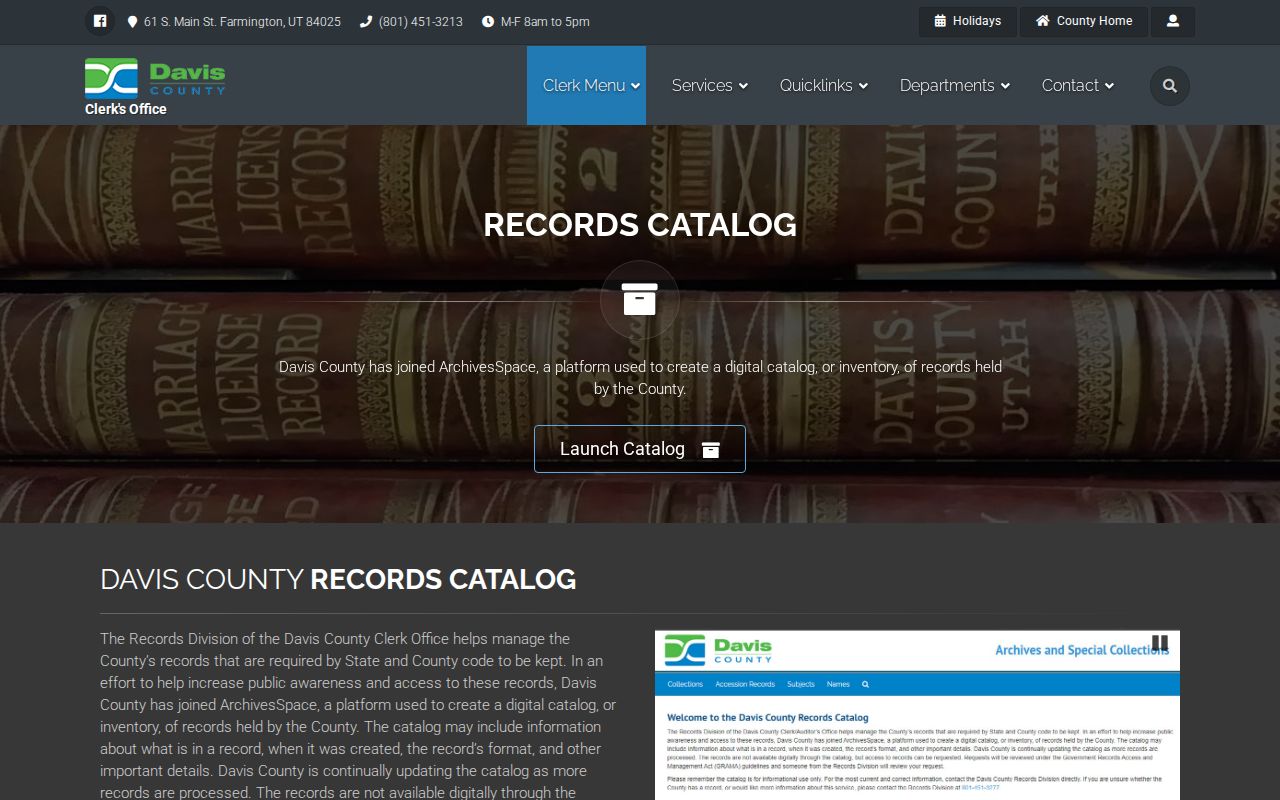
A catalog description is not the digital record itself. The ArchivesSpace entry helps identify a collection, but a reader must request the underlying material. For a filed criminal case, begin with the appropriate Second District or justice court. For genealogy or local-history work, the catalog can help locate older government series without sending a researcher to the wrong criminal clerk.
Restricted, Sealed & Expunged Records
Juvenile delinquency cases are generally absent from public XChange. Expunged cases also disappear from its public results. BCI history remains subject-only or limited to authorized recipients, while victims, minors, personal identifiers, and parts of active investigations can receive added protection. An unserved warrant may be restricted. Expungement limits ordinary government access, but it does not force every old news story or nongovernment copy to vanish.
Utah waiting periods vary by outcome and level. BCI lists ten years for impaired-driving cases, seven years for an eligible felony, five years for a class A misdemeanor, four for class B, three for class C or an infraction, and 30 to 180 days for qualifying dismissal or acquittal circumstances. The person must also meet rules on sentence completion, payment, supervision, pending cases, protective orders, offense type, and conviction counts. Capital, first-degree, violent-felony, felony-DUI, and registerable sex offenses are major exclusions.
Davis County Clean Slate Records
Utah's automatic Clean Slate process changed on January 1, 2026. Courts again identify qualifying cases without the temporary request form used from October 2024 through December 2025. Automatic relief can include defined dismissals, acquittals, and low-level convictions after statutory waits. Traffic expungement follows a direct court route because BCI does not index expunged traffic matters. Anyone relying on older instructions should compare them with current Utah Courts and BCI material.
The BCI expungement page explains eligibility checks, certificates, exclusions, and current processing guidance.
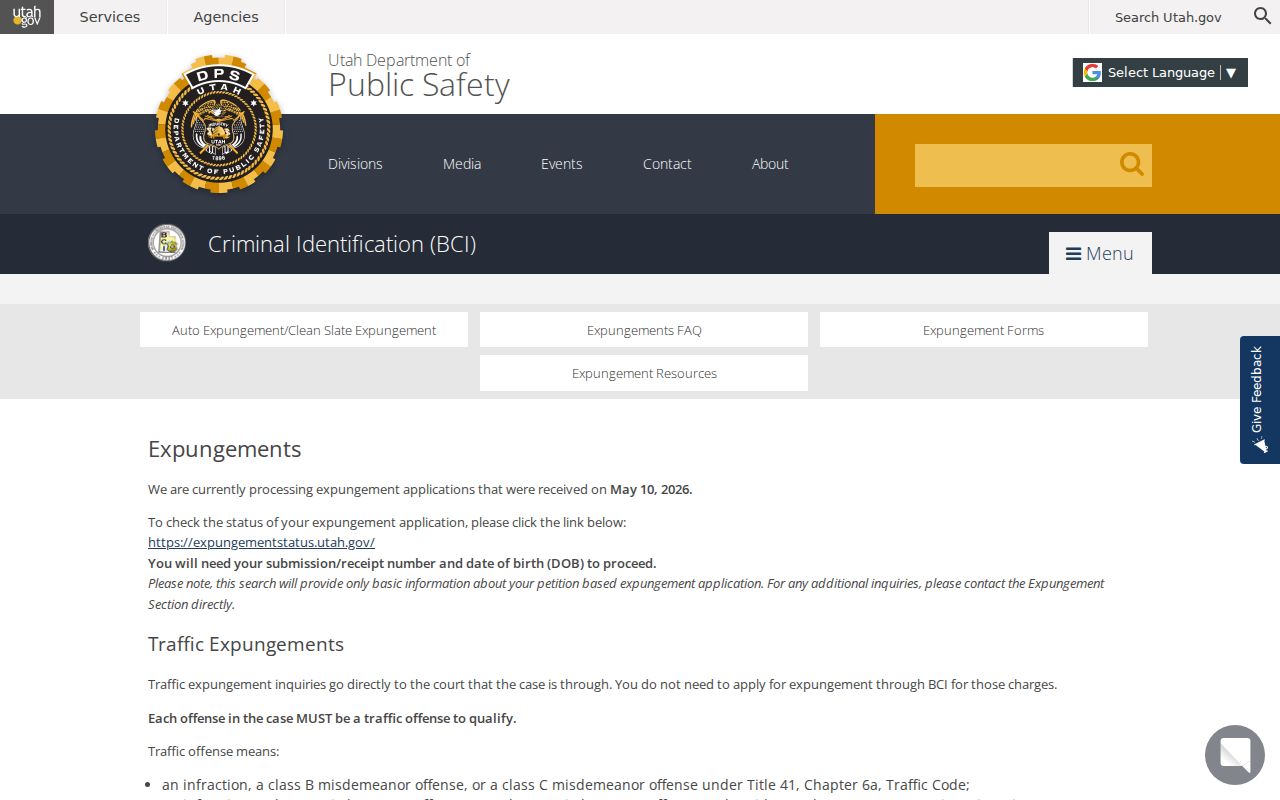
The ordinary petition route starts with a $65 BCI application and fingerprints. An eligible conviction, plea-in-abeyance, or special certificate costs $65 per case, while qualifying dismissal, acquittal, or declination certificates have no certificate fee. Court filing charges may also apply, and a fee waiver may be requested through the court. The Certificate of Eligibility, petition, and proposed order go to the court of judgment. The prosecutor may object, victim notice may apply, and the judge makes the decision. The official expungement status lookup accepts the submission or receipt number and date of birth.
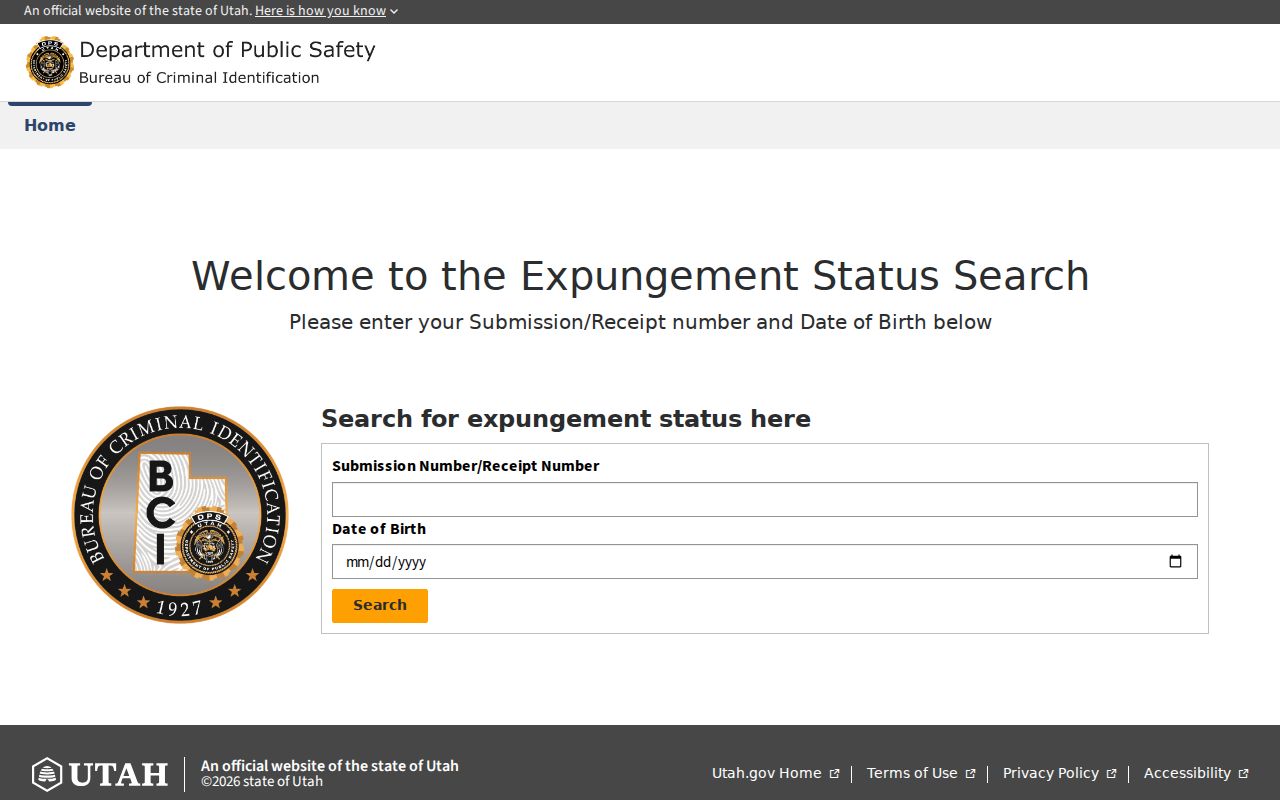
The status tool tracks the BCI application, not the full court process. When the research was checked, BCI showed that it was processing applications received April 10, 2026. That is a dated backlog snapshot, not a promised turnaround. After an order is processed, verify the personal BCI record and MyCourtCase status. Public XChange should no longer show the expunged case, while BCI retains a restricted file for statutory exceptions.
Davis County Warrant Record Checks
Start with Utah's statewide public warrant name search, then confirm the result with the issuing court. Davis County Justice Court checks its own warrants by phone from 9 a.m. to 3 p.m. on weekdays at 801-451-4488. The sheriff FAQ also gives the BCI warrant line, 801-965-4437, around the clock for court, case, and warrant numbers. XChange can show the related case history. Municipal bench warrants should be confirmed with that city's justice court.
An empty result is not proof that no warrant exists. Spelling, a recent issue or recall, restricted unserved process, sealed matters, and federal or out-of-state cases can cause gaps. Call the issuing court and ask about appearance, hearing, or bail instructions. Davis County Justice Court says scheduling alone does not recall its warrant; it stays active until bail is paid or the person is seen by a judge. A local court can resolve only its own process.
Davis County also warns of callers seeking Bitcoin or fees for supposed early release through ankle monitoring. The county's ankle-monitor program is court ordered and does not require direct family payment. Do not pay a caller. End the call, use a known sheriff number, and verify the person's status through the official jail or court channel.
City-by-City Criminal Records in Davis County
Layton, Bountiful, and Syracuse are Davis County's three largest incorporated cities in the Census Vintage 2025 estimates. Each police department creates its own incident records, while booking usually shifts to the Davis County Correctional Facility and filed cases move to the court with jurisdiction. Their request methods are not alike. Layton uses online, mail, and counter channels; Bountiful also publishes an email route; Syracuse accepts a written request online or by returned form, including email or fax.
The city guides keep those local distinctions clear. They also separate police reports from court files. Layton and Bountiful have Second District locations, while Syracuse operates a justice court for city class B and C misdemeanors and infractions. A city police portal will not supply the later judge's docket or final disposition.
Layton Record Check
85,308 residents · Police reports at 429 N Wasatch Drive; district records use the separate court.
Bountiful Record Check
44,988 residents · Police Records and Second District share 805 S Main but keep separate files.
Syracuse Record Check
39,909 residents · Written police channels and a local justice court require distinct requests.
Davis County Criminal Record History
Davis County is Utah's smallest county by land at 223 square miles, yet it had an estimated 381,227 residents in 2025 and ranked third by population. Its narrow strip between the Great Salt Lake and the Wasatch Range helped form closely spaced cities with many local police custodians. The county reports a typical daily jail population near 800. A 2024 tentative budget projected more than 10,000 bookings for 2023, nearly 2,000 above 2022, while also housing federal and Utah contract inmates. Those figures explain why a current roster is only a snapshot.
The records landscape has deep roots. Utah's first courthouse was a two-story adobe building, and one east room became a jail in 1861. The later Memorial Courthouse grew through major work completed in 1932, then additions in the 1950s and 1979. A 1997 renovation exposed an ornate ceiling from the 1890 building. That courthouse history is useful for archival research, but current criminal case files route to the justice complex and Utah Courts. The old building should not be used as a default criminal-record counter.
Modern Davis County programs also create distinct records. Adult Probation and Parole runs the Region 2 Farmington office at 883 W 100 North, while the Utah Board of Pardons and Parole makes parole decisions. The Farmington Treatment Resource Center offers counseling and structured programs. Davis Drug/DUI Court and Mental Health Court add specialized court activity, but program participation does not make protected treatment details public. The docket and governing access classification still control.