
Layton Criminal History Checks
A useful Layton record check begins by naming the event and the document sought. Layton Police Records can locate a report from an incident investigated by Layton officers. The Layton court file answers what charge was filed and how it ended. The Davis County roster answers whether someone is now in county custody. BCI supplies a person with their own statewide Utah history, not an open name search of other people. Those Layton boundaries prevent a common error: treating one local report as a full criminal history.
Use the case number when it is known. Without one, Layton asks for enough detail to locate the event, such as the place, date, involved people, and a clear report description. Identity evidence matters when the requested material is not public to everyone.
Recent activity and final outcomes also call for different tools. A new custody event may reach the Davis roster before a prosecutor files anything. An older Layton case is more likely to have a useful charge-level history in XChange. For personal review, compare that judicial result with the record supplied through the proper subject-access channel.
- Open the official Layton Police Records channel and identify the incident, report, or personal record product needed.
- Submit the request online, at the counter, or by mail. Include proof of identity when access depends on the requester.
- Check Utah court records for a filed charge, plea, disposition, sentence, or bench warrant tied to a court case.
- Use the Davis County jail roster when the question is current booking or custody rather than the police narrative.
- Request BCI Right of Access when reviewing your own statewide Utah criminal history.
For a county-wide view of how Layton systems differ, the Davis County criminal history overview separates police, jail, court, and BCI sources.
Layton Police Records Counter
Layton Police Records is at 429 North Wasatch Drive. Staff can be reached at 801-336-3530, and the published counter schedule is Monday through Friday, 8 a.m. to 5 p.m., excluding legal holidays. The nonemergency police number is 801-497-8300. A counter visit can help when identity must be shown or the requester is unsure which event details will locate the file.
The captured official Layton Police Records page documents Layton's record channels and release limits.
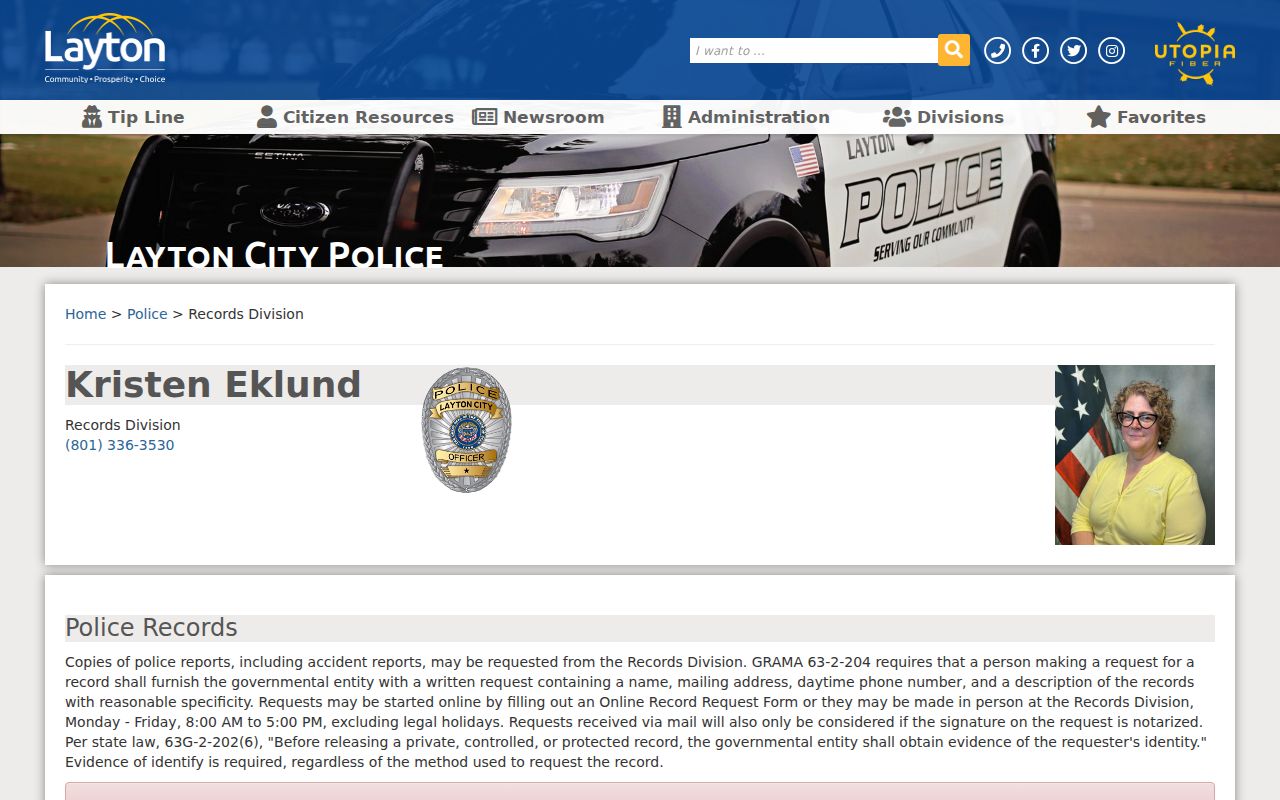
That source is the best place to confirm current Layton request terms before sending a Layton police report request. Layton police material may be public, private, protected, or controlled under Utah law, so access can turn on both the record and the requester's relationship to it.
Layton Police Records
429 N Wasatch Drive
Layton, UT
801-336-3530
Monday-Friday, 8 a.m.-5 p.m.
Closed legal holidays
Records at the Layton Police Department
The Layton Police Department creates incident and arrest reports for events its officers handle. Those records can include the narrative, involved parties, dates, locations, alleged offenses, evidence references, and officer information. Release is not automatic merely because a form is online. Active investigations, victim data, juvenile information, and private identifiers may be withheld or redacted.
The Layton Police Department source provides the official department entry point.
The Layton department page helps distinguish routine Layton agency contacts from the Layton Police Records workflow. A caller seeking a judge's ruling or final conviction should contact the Layton filing court instead, because Layton police do not maintain the judicial docket.
Mailed Layton Record Requests
Layton publishes online, in-person, and mail routes for police records. The mail route carries one important extra step: the requester's signature must be notarized. The notarization authenticates the signature; it does not make a restricted report public. A mailed request without it may be delayed while staff seeks the missing proof.
Across all Layton routes, provide requester identity and contact details, a daytime phone number, and government identification when needed. Add the Layton case number if known. If it is not known, describe the occurrence date, address, people involved, and the exact record sought. That focused description helps Layton staff find the right file and limits needless media preparation.
Note: A notarized signature is required for a mailed Layton request, while identity evidence can matter through every submission method.
Booking and Arrest Records in Layton
Layton officers create the arrest paperwork, but Layton does not operate the jail identified in the research. People booked after a Layton arrest route to the Davis County Correctional Facility in Farmington. The county jail then creates the custody record, booking date, identifying details, and current roster entry. This split means the Layton report and county booking record may describe the same event from different custodial points.
For recent Layton custody, check the official Davis County inmate roster. Historical Layton booking details may require a county GRAMA request. A booking allegation is not a conviction. Once a prosecutor files a Layton case, the court record becomes the better source for the actual charge and its outcome. The dedicated Davis County arrest search covers county booking channels in more depth.
Layton Resident Record Products
Layton offers two local products with narrow uses. A resident may request their own Utah criminal history for $15 by showing state or federal photo identification. It is an own-record, Utah-only service. It is not a nationwide check and does not open another person's BCI file.
A free letter of good conduct is also available to a Layton resident when Layton Police has no criminal conviction for that person. Layton notes personal travel and visa needs as common reasons. The letter speaks to the Layton Police record described by Layton. It does not replace BCI Right of Access, an FBI Identity History Summary, or a certified court case file.
- Own Utah criminal history
- The requester's own Utah record requires photo ID and has a published $15 fee.
- Letter of good conduct
- This Layton Police conviction check for a city resident has no charge.
- Incident report
- One identified Layton police incident has a published $10 fee.
The Layton Municipal Court File
Layton does not provide a separate public Layton case-search portal in the research. Judicial records use Utah Courts channels. Second District Court at 425 North Wasatch Drive, 801-444-4300, handles Davis County felony and class A misdemeanor files. Justice-court channels cover lower-level matters within their jurisdiction. XChange supports broader public Layton case history, while MyCourtCase is for authenticated party access.
| Court Name | Utah Courts, including Second District Court in Layton and the applicable justice court |
|---|---|
| Case Types Heard | Second District hears felonies and class A misdemeanors; justice courts hear class B and C misdemeanors, infractions, and ordinances |
| Case Lookup Channel | Utah Courts XChange, courthouse terminal, MyCourtCase for a party, or filing clerk |
| What the Docket Shows | Filed charges, plea, judge, hearings, disposition, sentence, finance entries, and available public documents |
| Copies & Fees | Confirm certified-copy terms with the filing clerk; remote XChange has its own published charges |
The Layton police and court counters sit close together on Wasatch Drive, yet they are separate custodians. The Layton police report gives the agency narrative. The Layton court file gives the judicial history and final charge-level result.
Layton Police Service Menu
Layton's secure services menu separates tasks that can sound alike. “Request a Police Report” is the incident-report path. “City Record (GRAMA Request)” is the broader municipal-record route. “Fingerprinting Appointment” schedules capture rather than searching a record. “Pay Discovery” is a payment and delivery function, not the public XChange case lookup.
The official Layton online services menu shows these distinct choices.
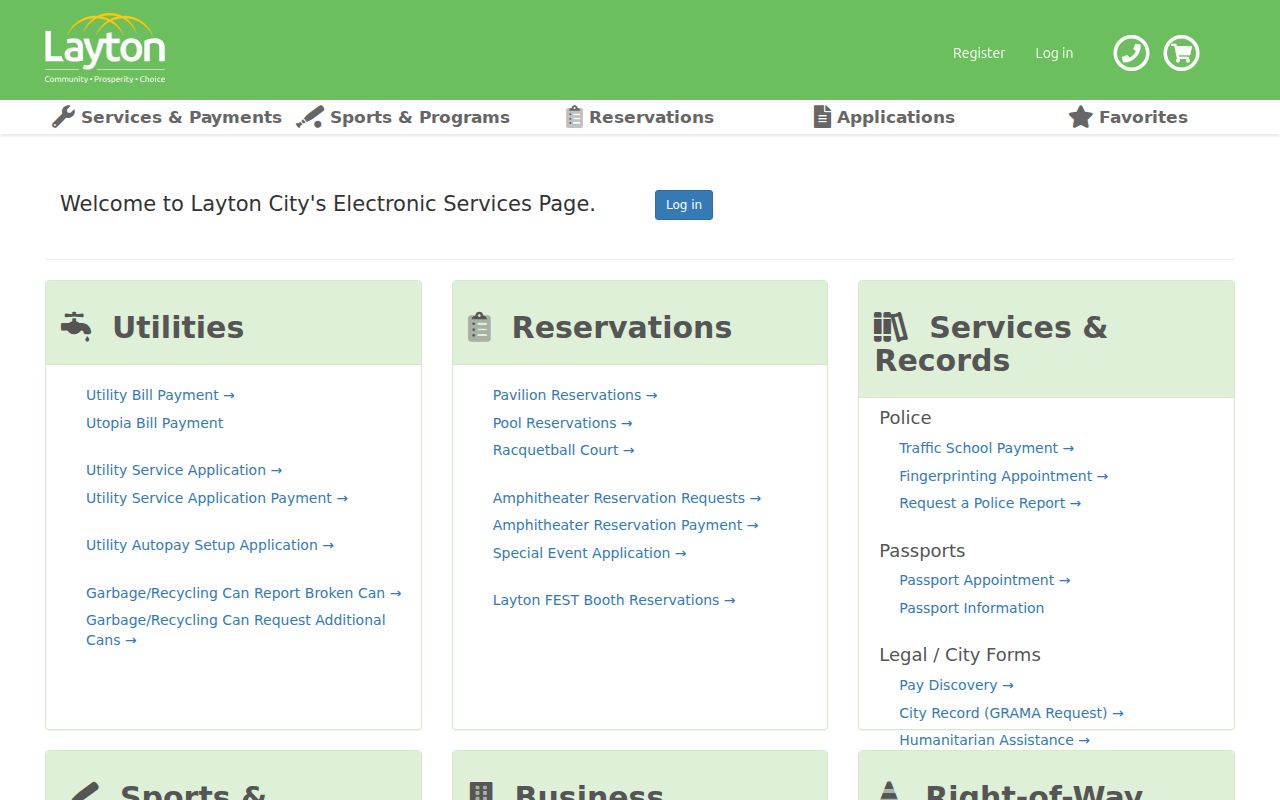
Selecting the right service prevents a request from reaching the wrong custodian. The secure inner fields were not captured in the research, so requesters should read the live form and avoid assuming fields beyond the confirmed practical details.
| Menu item | What it does | What it does not do |
|---|---|---|
| Request a Police Report | Starts the secure incident-report request | Does not show a court disposition |
| City Record | Routes a broader GRAMA request | Is not automatically the police-report path |
| Fingerprinting Appointment | Schedules print capture | Is not a name search |
| Pay Discovery | Handles discovery payment or delivery | Is not public XChange |
How Layton Records Reach the County
A Layton event can create several files. Police write the initial report and, when an arrest occurs, submit the law-enforcement data. The Davis County jail creates booking and custody entries. A city prosecutor or the Davis County Attorney decides what to file based on the offense and jurisdiction. Court staff then record pleas, hearings, dispositions, and sentences. Fingerprint-supported arrest data and reported results may flow to BCI.
Record flow: Layton Police Department › Davis County jail and courts › Utah Department of Public Safety, Bureau of Criminal Identification
Timing explains why sources can disagree. Police may hold an incident with no filed case. The jail may show a booking before a court result exists. A court disposition can differ from the arrest allegation. For a full Layton record check, match identifiers and read each charge's final disposition.
Layton Police Report Fees
The current official Layton records page lists $10 per incident report. Photos, audio, or video cost $30, including the first hour of preparation and redaction, then $15 for each extra hour. A stale Layton FAQ reportedly showed $5, but the current Layton records page controls unless Layton confirms otherwise.
Media work can grow with the length and amount requested. Describe the exact clip, photo set, or time range needed and ask for an estimate. A narrow request reduces the risk of paying for preparation of material that does not answer the question.
| Record | Current published charge |
|---|---|
| Incident report | $10 per report |
| Photos, audio, or video | $30, including first preparation/redaction hour |
| Additional preparation/redaction | $15 per additional hour |
Layton Police and Court Records
Searching only one Layton system leaves gaps. A police report may document an event that never became a filed criminal case. A court search may show an amended charge or dismissal but omit the full incident narrative. A bench warrant belongs to the issuing court, not Police Records, even when Layton officers may later execute it.
Use Police Records for the agency-created report and released media. Use the county roster for present custody. Use XChange or the filing clerk for the case history. When reviewing your own statewide record, use BCI. These records are related, but none can be used as a substitute for all the others.
Note: Match the event across custodians before drawing a conclusion, since arrest charges and final court dispositions can differ.
Layton Record Access Rules
GRAMA gives the public a right to inspect public government records, subject to classification, redaction, and allowed fees. A written Layton request should give contact details and a reasonably specific description. Ordinary GRAMA timing is up to ten business days, while qualifying expedited public-benefit requests can have a shorter period.
BCI history is different. Utah law restricts repository criminal history to the subject and authorized recipients or uses, which is why there is no open statewide rap-sheet name search. Court records follow judicial classification rules, and sealed, private, protected, juvenile, or expunged material does not appear in ordinary public access.
Key Statutes:
Utah Code §63G-2-201 permits inspection and copies of public government records, subject to lawful limits.
Utah Code §63G-2-204 sets request content and standard response timing.
Utah Code §53-10-108 restricts dissemination of BCI criminal history.